Shipping🇺🇸 USA
Digit
by Agility Robotics (Amazon) · humanoid · Announced 2017 · Shipped 2022
$250,000
Purpose-built logistics humanoid deployed at Amazon fulfillment centers for tote transfer in human-scale environments.
Overview
The Digit is a humanoid developed by Agility Robotics (Amazon) (USA), first announced in 2017 (shipping since 2022). It is commercially available. Standing 175 cm tall, weighing 65 kg, with 16 degrees of freedom, it can carry payloads up to 16 kg. Performance highlights include a top speed of 1.5 m/s, a battery runtime of 240 minutes. The platform is ROS2 compatible, equipped with 4x Intel RealSense depth cameras, LiDAR, MEMS IMU, force sensors. Pricing starts at $250,000.
Digit — use cases
Bulk tote transfer at GXO Logistics
Agility's first publicly-disclosed commercial Digit deployment runs at GXO Logistics' Spanx fulfillment center in Flowery Branch, Georgia, announced June 2024. Digit units move totes between conveyors and Autonomous Mobile Robots (AMRs). GXO described the engagement as a multi-year Robots-as-a-Service contract; per-tote cycle times and how many shifts Digit covers have not been disclosed.
Amazon fulfillment sortation pilots
Amazon began testing Digit at its BFI1 facility near Seattle in October 2023, following the April 2023 strategic investment from Amazon Industrial Innovation Fund. Tasks center on recycling and tote handling. Amazon has framed this as research-stage; no production-scale Digit fleet inside Amazon has been confirmed by either party. Digit competes inside Amazon against the Sparrow arm and Proteus AMRs for warehouse task allocation.
Last-mile and dock-to-warehouse research with Ford
Ford partnered with Agility in 2020 on a research project pairing Digit with delivery vehicles for the last 30 metres of a delivery — robot exits van, walks parcel to door. The program produced demos but no production rollout. Ford has not extended the partnership publicly since 2022; Agility has since shifted commercial focus to indoor warehouse tasks where Digit's 1.5 m/s max speed and 240 min runtime are better matched.
RaaS pricing transparency
Agility CEO Damion Shelton has publicly quoted a target operating cost in the $30/hr range for Digit-as-a-service contracts (TechCrunch Disrupt 2024 interview), framing the platform against minimum-wage labor across two or three shifts. This is one of the few public RaaS numbers in the humanoid market — Figure, 1X, and Tesla have not disclosed equivalents.
Forward-facing digitigrade legs
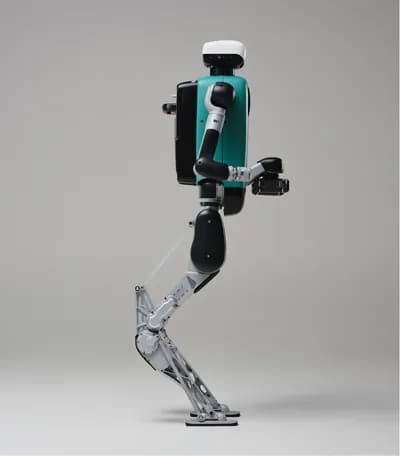
Digit's legs articulate forward like a bird's (digitigrade) rather than plantigrade like Atlas or Optimus. This stems from Cassie, the Oregon State research platform Digit descends from. The choice gives lower energy use for sustained walking and lets the robot squat under conveyor lines, but limits stair navigation to standard step heights and rules out steep ladders or scaffolds.
Version history
Cassie (research predecessor) — 2017
Bipedal legs-only research platform from Oregon State spin-out, no torso, no arms. Set walking efficiency benchmarks that informed Digit's design. Cassie is not a product — research labs purchased units, but no commercial workload ran on it.
Digit V1 — Unveiled 2019
First Digit reveal with full upper body, gripper-style end effectors, and Ford partnership announcement. Production volumes were single-digit; the platform was demonstrative.
Digit V3 / V4 commercial — 2022 onwards
First Digit generation shipped to paying customers (Agility has not publicly named the V3/V4 split). Added LiDAR, improved IMU, larger battery, and the head camera mast. This is the configuration currently deployed at GXO.
RoboFab production facility — September 2023
Agility opened a Salem, Oregon manufacturing facility branded RoboFab, stated capacity of 10,000 Digit units per year at full ramp. Actual 2025-2026 shipped units are below 1,000 by Agility's own commentary at Automate 2025 (Damion Shelton interview).
ISO 13482 safety certification work — In progress as of 2026
Agility has stated publicly (multiple Shelton interviews 2024-2025) that ISO 13482 certification for personal-care/service robots is in progress for Digit. No competitor has shipped a humanoid with completed ISO 13482; certification would be a significant procurement differentiator for industrial customers requiring documented safety compliance.
Deployment evidence
GXO Logistics — Flowery Branch, Georgia, USA
Spanx-tenanted fulfillment center. First publicly-disclosed commercial Digit deployment. Tote-to-conveyor and tote-to-AMR transfers. RaaS contract announced June 2024; GXO has not published scale-up numbers since.
Source: https://gxo.com/news/digit-humanoid-robot/
Amazon BFI1 — Sumner, Washington, USA
Research-stage tote and recycling tests as part of Amazon Industrial Innovation Fund engagement. Pilot disclosed October 2023; subsequent expansion has not been confirmed by Amazon.
Source: https://www.aboutamazon.com/news/operations/amazon-digit-robot-trial
Schaeffler Group — Schweinfurt, Germany (research)
Schaeffler announced a Digit research partnership in 2024 covering bearing-line material handling tests. Production rollout has not been disclosed.
Source: https://www.schaeffler.com/en/news_media/press_releases/
Manhattan Associates SCALE 2024 — demo floor
Public demonstrations integrating Digit with Manhattan Associates' warehouse management system showed real-time order-driven task assignment. This is integrator validation, not a production site.
Known limitations
Gripper, not hands
Digit uses a two-finger pinch gripper on each arm, not articulated hands. Bimanual manipulation, tool use, and dexterous tasks are out of scope. For pick-and-place of totes, parcels, and boxes this is sufficient; for assembly, sorting small items, or operating human-designed tools, Digit is not the right platform. Figure 02, Apollo, and Atlas all offer richer end-effectors.
16 degrees of freedom is low for the category
Median DoF across the 43 humanoids in our catalog is 36. Digit's 16 is at the bottom of the distribution. The trade-off is reliability and safety — fewer joints, fewer failure modes, easier safety certification — but it caps the task envelope. Whole-body manipulation tasks that require coordinated trunk-arm movement are limited.
Compute platform not publicly disclosed
Agility lists 'N/A' for onboard compute specifications publicly. Customers integrating Digit do not have published reference for Jetson model, RAM, or GPU compute units. This contrasts with Unitree (Orin variants stated), Pollen (Orin Nano), and Booster (Thor announced). Procurement-stage customers receive details under NDA.
No outdoor operation
Digit is rated for indoor environments only. IP rating is not publicly disclosed; Agility marketing materials and all confirmed deployments are indoor. Outdoor logistics tasks — yard moves, parking lot transfers — are out of scope. Boston Dynamics Atlas Electric and Apptronik Apollo are similarly indoor; only research platforms like the original Cassie have demonstrated outdoor walking.
$250K price tag versus Chinese alternatives
Digit's $250K list price (Agility's stated RaaS-implied capital equivalent) is competitive with Atlas Electric ($320K) and well above Unitree H1-2 ($90K) or AgiBot A2 (price not disclosed but reportedly under $50K). For warehouse buyers comparing per-unit cost rather than capabilities, Digit is the premium option in a segment where Chinese vendors are pushing aggressive pricing.
How Digit compares
vs. Boston Dynamics Atlas Electric
Atlas Electric and Digit are the two USA-built all-electric warehouse humanoids targeting industrial buyers in 2026. Atlas has more DoF (29 vs Digit's 16), higher payload (40 kg vs 16 kg), and more aggressive whole-body motion. Digit has the production scale lead (RoboFab capacity, deployed RaaS contracts) and a more established commercial customer reference (GXO). Atlas is $320K; Digit $250K. For high-payload single-task warehouse work, Atlas; for repeatable tote-transfer at scale today, Digit.
vs. Apptronik Apollo
Apollo and Digit are the two USA-built humanoids with publicly-named Fortune-500 industrial customers (Apollo at GXO and Mercedes-Benz; Digit at GXO and Amazon). Apollo has anthropomorphic hands and 35 DoF (vs Digit's 16); Digit has the bird-like legs and longer 240-min runtime (Apollo: 240 min stated as well). Both target the same warehouse buyer; Apollo emphasises versatility (assembly + logistics), Digit emphasises specialisation (logistics-only). Pricing comparison is hard — Apptronik has not disclosed list price; Digit is $250K RaaS-implied.
vs. Unitree H1
Unitree H1 ships at roughly $90K against Digit's $250K — a 2.8× difference. H1 has more DoF (27 vs 16), higher max walking speed, and the same ROS2 native support. What H1 lacks is documented commercial customers, RaaS contract structure, and safety certification work. For research labs and integrators willing to build their own logistics stack, H1 is the better economics. For procurement teams wanting a turnkey solution with named customer references, Digit closes that gap — at price.
Specifications
Height
175 cm
Weight
65 kg
DOF
16
Payload
16 kg
Runtime
4h
Max Speed
1.5 m/s
Battery
—
Charge Time
—
Stairs
Yes
LiDAR
Yes
Compute
—
ROS
ROS2
Platform
Sensors
4x Intel RealSense depth camerasLiDARMEMS IMUforce sensors
Operating System
Agility SDK (Python)
Last updated: 2026-06-23 · Announced 2017 · Shipped 2022
FAQ
Q.What is the price of Digit?
The Digit is priced at $250,000 USD.
Q.What are the specs of Digit?
Digit features 16 DOF, 175cm, 65kg, 16kg payload, 240 min runtime. N/A, ROS2.
Q.Is Digit available to buy?
Yes, Digit is currently shipping to customers.
Q.Who makes Digit?
Digit is made by Agility Robotics (Amazon), headquartered in USA. Official manufacturer site: https://www.agilityrobotics.com.
Q.Does Digit support ROS?
Yes. Digit supports ROS2, which makes it compatible with the broader Robot Operating System ecosystem and tooling.
Q.How long does the Digit battery last?
Digit runs for approximately 4h on a single charge.
Q.What payload can Digit carry?
Digit is rated to carry up to 16 kg of payload, suitable for light industrial and research workloads.
Q.How fast is Digit?
Digit has a published maximum walking speed of 1.5 m/s and can navigate stairs.
Q.What are alternatives to Digit?
Closest specs-wise alternatives to Digit include A2 by AgiBot (Zhiyuan Robotics), 4NE-1 by NEURA Robotics, Walker S2 by UBTECH Robotics. Full head-to-head comparison: https://biorobot.ai/en/vs/agibot-a2-vs-agility-digit.