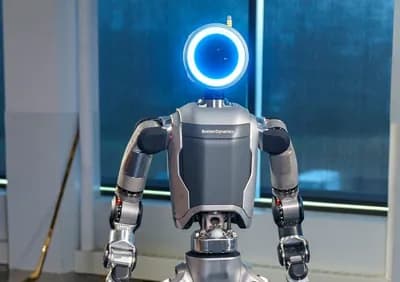
Development🇺🇸 USA
Atlas (Electric)
by Boston Dynamics (Hyundai) · humanoid · Announced 2024
~$420,000 (enterprise estimate)
Boston Dynamics' fully electric successor to hydraulic Atlas, with autonomous battery swapping and NVIDIA AI stack for industrial deployment.
Overview
The Atlas (Electric) is a humanoid developed by Boston Dynamics (Hyundai) (USA), first announced in 2024. It is currently in development. Standing 152 cm tall, weighing 89 kg, with 28 degrees of freedom, it can carry payloads up to 50 kg. The platform is powered by NVIDIA Jetson Thor, ROS2 compatible, equipped with Stereo cameras, RGB cameras, depth sensors, LiDAR, and 2 more sensor types.
Atlas (Electric) — use cases
Engine cover handling at Hyundai Motor Group plant
Boston Dynamics published video in October 2024 showing Atlas Electric autonomously moving engine covers between sequenced fixtures at a Hyundai facility. The task uses the 50 kg rated payload and the robot's full 28 DoF body articulation, including the head-down posture and back-bend that the electric joints permit. Cycle time and accuracy figures have not been disclosed by Boston Dynamics or Hyundai.
Tote and parts movement for sequenced kitting
Subsequent Boston Dynamics demos in 2025 showed Atlas walking with totes between racks and inserting parts into receptacles. The 50 kg payload covers larger automotive components than competitor humanoids in the 10-25 kg class can handle. Boston Dynamics has positioned this workload as the wedge into Hyundai's existing logistics processes already automated by Spot quadrupeds and Stretch box-moving robots.
Hyundai Motor Group plant pilot, phased through 2026
Hyundai and Boston Dynamics announced a multi-year deployment plan starting late 2025 with a small fleet at one Hyundai facility, scaling through 2026. The plan was disclosed at the joint Boston Dynamics x Hyundai investor briefing in 2025; specific unit counts per quarter have not been published. The deployments are described as supervised pilots, not productive autonomous operation.
Recovery and floor-pickup demos
An April 2024 release video showed Atlas Electric standing up from prone, including the back-bend recovery that exploits the robot's range-of-motion advantage over hydraulic Atlas and over competing electric humanoids. Boston Dynamics described this as a robustness demonstration rather than a production cycle, but the capability matters for industrial deployment where robots will inevitably fall.
NVIDIA Isaac Lab training pipeline
Boston Dynamics joined NVIDIA's GR00T humanoid foundation model program in 2024. Atlas Electric runs Jetson Thor on-board compute and shares simulation data with Isaac Lab. The pipeline is positioned as a way to train manipulation behaviours without per-task hand engineering. NVIDIA and Boston Dynamics have not published benchmarks showing the foundation model outperforming Boston Dynamics' in-house controllers on real tasks.
Version history
Atlas (DARPA / hydraulic generations) — 2013 to April 2024
The hydraulic Atlas lineage ran for more than a decade, originating in the DARPA Robotics Challenge programme. It accumulated public demonstrations including parkour, gymnastics, and box-throwing, but the platform was research-only. Boston Dynamics retired hydraulic Atlas with a farewell video on April 16, 2024 and pivoted entirely to the electric design.
Atlas Electric — initial reveal — April 17, 2024
Revealed one day after the hydraulic farewell. The electric platform replaces hydraulic actuators with electric motors throughout. Specifications announced at launch: 152 cm height, 89 kg mass, 28 DoF, 50 kg payload, joint range of motion exceeding human anatomy in several axes (including 360-degree continuous rotation at hip and shoulder).
Hyundai partnership announcement — Late 2024
Boston Dynamics and parent Hyundai Motor Group announced the multi-year industrial pilot programme. Specific scope, unit counts, and revenue terms were not disclosed. Boston Dynamics framed the partnership as the path from R&D to recurring commercial deployment.
NVIDIA GR00T integration — March 2024 (announced) to 2025 (visible)
Atlas Electric adopted NVIDIA Jetson Thor for on-board compute and joined the Isaac Lab simulation environment. The choice of NVIDIA stack is notable because Boston Dynamics historically built its full robotics stack in-house; the GR00T partnership marks a shift toward shared foundation models for manipulation.
Commercial availability target — Hyundai pilots through 2026; broader commercial release timing not announced
Boston Dynamics has not published a date for general commercial availability outside Hyundai. Status remains 'development' in the public catalogue. The price point of approximately 420,000 USD is an enterprise estimate from third-party industry reports, not a published list price.
Deployment evidence
Hyundai Motor Group facility (single plant, location not publicly named)
First and only publicly documented deployment site as of early 2026. Tasks include engine cover handling and tote movement under supervised pilot conditions. Hyundai has not disclosed cycle counts, shifts run, or productivity comparisons against human operators or fixed automation.
Source: Boston Dynamics x Hyundai Motor Group joint press materials, 2024-2025
Boston Dynamics R&D campus, Waltham MA
Primary development and characterisation site. All publicly released Atlas Electric demo footage to date originates from Waltham. Robot fleet size at the campus has not been published by Boston Dynamics.
Source: Boston Dynamics press releases and YouTube channel, 2024-2025
NVIDIA GTC conference floor
Atlas Electric appeared at NVIDIA GTC 2024 and 2025 as part of NVIDIA's humanoid robotics showcase. These are demonstration appearances, not productive deployments. Boston Dynamics confirmed Jetson Thor adoption at these events.
Source: NVIDIA GTC keynote coverage, 2024 and 2025
External customers outside Hyundai Motor Group
Boston Dynamics has not announced any pilot or deployment customer outside Hyundai. The platform is not yet offered for general purchase. Interested industrial customers would currently route enquiries through the existing Spot and Stretch sales channel.
Known limitations
Battery runtime not disclosed
Boston Dynamics has published no battery capacity, runtime, or charge time figures for Atlas Electric. The product page lists the autonomous battery-swap capability but gives no shift-length numbers. For shift planning this is a material gap; competitors at lower payload ratings publish 2-4 hour runtimes.
Walking speed not published
No top walking speed figure has been released for Atlas Electric. Demo videos suggest a working pace comparable to other electric humanoids in the same weight class (roughly 1-1.5 m/s), but the absence of an official figure makes throughput modelling difficult.
Status remains development, not shipping
As of early 2026 Atlas Electric is not in production volume. The Hyundai pilot is small and supervised. Buyers planning commercial deployment in 2026 cannot procure units; the product enters a queue dependent on Boston Dynamics' internal scaling decisions and the Hyundai pilot outcome.
No published software SDK pricing or partner programme
Boston Dynamics has historically gated Spot SDK access through partner agreements. The same model is expected for Atlas Electric, but specific tier pricing, ROS 2 driver maturity, and third-party integrator access programme details have not been disclosed.
Total cost of ownership opaque
The ~420,000 USD figure circulating in trade press is unverified by Boston Dynamics. Service contracts, replacement battery costs, software subscriptions, and integration engineering hours are not public. Customers cannot build a credible TCO model from public information.
How Atlas (Electric) compares
vs. Figure 02
Figure 02 is the closest direct competitor on the US-headquartered, industrial-payload axis. Figure 02 is shipping under a BMW pilot (announced productive use in 2025), where Atlas Electric remains in supervised pilot. Atlas Electric carries 50 kg rated payload versus Figure 02's lower 20 kg figure, giving Boston Dynamics an edge for heavier automotive components. Figure has been more open about Helix VLM model deployment timing, while Boston Dynamics has shared less about its software stack.
vs. Apollo
Apollo is the other US-headquartered electric humanoid targeting industrial deployment, with Mercedes-Benz and GXO Logistics pilots. Apollo's 25 kg payload sits between Figure 02 and Atlas Electric. Apptronik publishes more detailed shift-length and runtime data than Boston Dynamics. For buyers prioritising published spec transparency, Apollo's data sheet is more complete; for buyers needing maximum payload, Atlas Electric leads.
vs. Digit
Digit is in productive deployment at Amazon and GXO, the only humanoid with verified third-shift commercial operation. Digit's bird-leg morphology and 16 kg payload target tote moves rather than heavy parts; the use-case overlap with Atlas Electric is partial. Where Digit competes for warehouse work, Atlas Electric competes for automotive line-side work. Buyers selecting between the two should map the task to morphology rather than to brand.
Specifications
Height
152 cm
Weight
89 kg
DOF
28
Payload
50 kg
Runtime
—
Max Speed
—
Battery
—
Charge Time
—
Stairs
Yes
LiDAR
Yes
Compute
NVIDIA Jetson Thor
ROS
ROS2
Platform
Sensors
Stereo camerasRGB camerasdepth sensorsLiDARforce sensingIMU
Operating System
ProprietaryNVIDIA Isaac
Last updated: 2026-06-23 · Announced 2024
FAQ
Q.What is the price of Atlas (Electric)?
The Atlas (Electric) price has not been officially announced yet.
Q.What are the specs of Atlas (Electric)?
Atlas (Electric) features 28 DOF, 152cm, 89kg, 50kg payload, N/A. NVIDIA Jetson Thor, ROS2.
Q.Is Atlas (Electric) available to buy?
Atlas (Electric) is currently in development and not yet available for purchase.
Q.Who makes Atlas (Electric)?
Atlas (Electric) is made by Boston Dynamics (Hyundai), headquartered in USA. Official manufacturer site: https://bostondynamics.com/products/atlas/.
Q.Does Atlas (Electric) support ROS?
Yes. Atlas (Electric) supports ROS2, which makes it compatible with the broader Robot Operating System ecosystem and tooling.
Q.What payload can Atlas (Electric) carry?
Atlas (Electric) is rated to carry up to 50 kg of payload, suitable for industrial logistics and warehouse workloads.
Q.What are alternatives to Atlas (Electric)?
Closest specs-wise alternatives to Atlas (Electric) include GR-1 by Fourier Intelligence, Figure 02 by Figure AI, Optimus Gen 2 by Tesla. Full head-to-head comparison: https://biorobot.ai/en/vs/boston-dynamics-atlas-electric-vs-fourier-gr1.