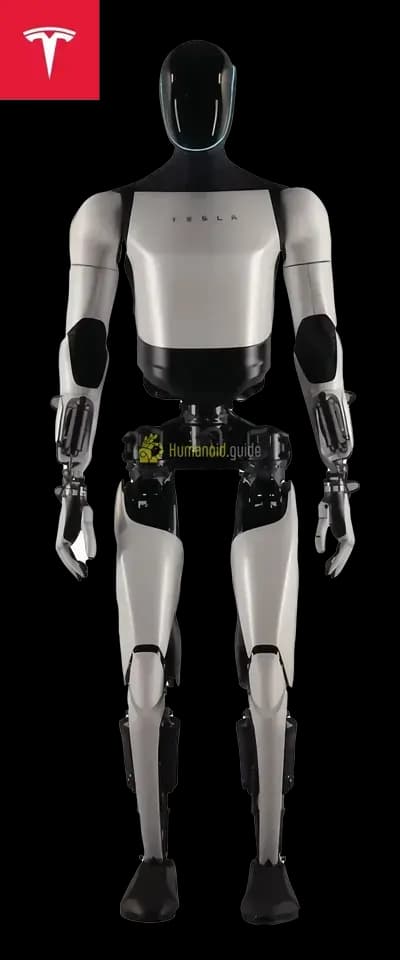
Development🇺🇸 USA
Optimus Gen 2
by Tesla · humanoid · Announced 2022
~$20,000 target (consumer, long-term)
Tesla's bipedal humanoid designed for autonomous factory tasks, leveraging FSD neural networks and manufactured entirely in-house.
Overview
The Optimus Gen 2 is a humanoid developed by Tesla (USA), first announced in 2022. It is currently in development. Standing 168 cm tall, weighing 57 kg, with 28 degrees of freedom, it can carry payloads up to 20 kg. Performance highlights include a top speed of 2.2 m/s, a battery runtime of 480 minutes, a 2300 Wh battery pack. The platform is powered by Tesla FSD custom SoC, equipped with 8x cameras (Autopilot-heritage), tactile fingertip sensors, force/torque joints, IMU.
Optimus Gen 2 — use cases
Battery cell sorting at Tesla Fremont
Tesla has demonstrated Optimus Gen 2 sorting 4680 battery cells into trays at the Fremont plant. The task uses the 11-DoF hands and tactile fingertip sensors to identify cell orientation. Tesla has not published cycle times or accuracy figures, but the company described the workflow on the Q3 2024 earnings call and in subsequent video releases.
Parts handling on the Cybertruck line
The December 2023 reveal video showed Gen 2 walking the Cybertruck production area at Fremont. Reported tasks include moving small components between stations and shelving operations. The 20 kg rated payload (Tesla figure) covers most line-side small-parts movement but excludes powertrain assemblies and full battery packs.
Quality inspection of structural castings
Multiple Tesla videos in 2025 showed Gen 2 units positioned next to mega-castings, where the 8 Autopilot-heritage cameras run visual inspection routines. Throughput per shift has not been disclosed, and Tesla has not stated whether human inspectors still verify the output.
Gym and balance demonstrations
Tesla published footage of Gen 2 squatting with controlled depth and lifting an egg without breaking the shell. These are scripted demos, not production workflows, and they illustrate the torque-controlled actuators and articulated fingers rather than commercial deployment.
Internal data collection for Gen 3 training
By the Q4 2025 earnings call (January 28, 2026), Tesla reported roughly 300 Optimus units deployed across its own factories. Elon Musk described this fleet as a learning phase: the robots generate teleoperation traces and autonomous failure logs that feed the Gen 3 training stack. They are not, by Tesla's own description, performing productive tasks at production-grade reliability yet.
Version history
Optimus Gen 1 (Bumble C prototype) — September 30, 2022
Tesla unveiled the first walking prototype at AI Day 2. The unit had off-the-shelf actuators in early demos and a Tesla-designed alternative shown statically. Weight was approximately 73 kg. The robot walked unsupported for a few minutes onstage.
Optimus Gen 2 — December 12, 2023
Full Tesla-designed actuator stack, 10 kg lighter than Gen 1, 30 percent faster walking gait, 11-DoF hands replacing the earlier 6-DoF version, 2-DoF actuated neck, articulated toe sections, and tactile fingertip sensors. The 8-camera vision system reuses parts of the Autopilot vision pipeline.
Gen 2 hand revision ("v2.5") — Mid-2024 (Tesla has not given an exact release date)
Tesla showed a revised hand design in mid-2024 with 22 DoF instead of 11. The upgraded hand appeared on internal demo units before being folded into Gen 3 production specs.
Optimus Gen 3 — Production start January 21, 2026 at Fremont
Tesla's first design intended for mass production. As of Q4 2025 reporting, around 300 units have been built, primarily for internal learning. Tesla has not released the full Gen 3 spec sheet. Public statements indicate higher-DoF hands, a redesigned actuator package, and updated FSD-derived compute. Target output for end of 2026 is 50,000 to 100,000 units per Musk's CES 2025 figures.
Deployment evidence
Tesla Fremont, California
First documented site of Optimus deployment. Tasks have included battery cell sorting, parts handling, and quality inspection of castings since mid-2024. Fremont is also the production site for Gen 3 units since January 2026.
Source: Tesla Q3 2024 and Q4 2025 earnings commentary
Tesla Giga Texas, Austin
Secondary deployment site since 2024. The same task mix as Fremont was demonstrated in Tesla videos. Giga Texas is also the location of a planned dedicated Optimus production facility targeting 10 million units per year, with first lines projected for 2027 per Tesla's public statements.
Source: Tesla investor materials, 2025
External customers
Tesla has not disclosed any external customer deployments of Gen 2. The robot remains an internal fleet. The earliest external delivery cited by Tesla is consumer availability around end of 2027, paired with Gen 3-derived hardware.
Known limitations
Closed software platform
Optimus runs Tesla's proprietary stack. There is no ROS or ROS 2 support, no published SDK, and no third-party app ecosystem. Researchers and integrators who want to extend humanoid behavior are pushed to platforms like Unitree H1 or Boston Dynamics Atlas Research instead.
Battery runtime is a manufacturer figure
The 480-minute runtime listed by Tesla is an idle or light-load figure. Tesla has not published a duty-cycle table covering payload, walking duty, or hand-actuation load. Real production runtime under continuous parts handling will be lower, but how much lower remains undisclosed.
No published reliability metrics
Tesla has not released mean time between failures, joint wear data, or fleet uptime numbers for the deployed units. Without these, total cost of ownership claims by Tesla cannot be checked against typical industrial robot disclosures.
Payload rating is conservative-looking but unverified
The 20 kg rated payload places Gen 2 below Figure 02 (25 kg) and on par with Agility Digit (around 16 kg). Tesla has not published the duty cycle, lift arc, or center-of-mass envelope under which 20 kg is sustainable, so the figure is not directly comparable to industrial humanoid datasheets that include these qualifiers.
Vision-only sensing without LiDAR
Tesla extended the camera-only Autopilot philosophy to Optimus. There is no LiDAR or structured-light depth sensor. In low-contrast factory lighting and reflective metallic environments, vision-only stacks have known degradation modes that Tesla has not publicly addressed for the humanoid context.
How Optimus Gen 2 compares
vs. Figure 02
Figure 02 (Figure AI) is the most direct US-market competitor by deployment posture. Figure has confirmed a paid commercial deployment at BMW Spartanburg, while Tesla has only an internal fleet. Figure 02 uses dual NVIDIA RTX GPU modules versus Tesla's FSD-derived custom SoC, and rates a higher 25 kg payload against Tesla's 20 kg. Figure walks more slowly (1.2 m/s versus Tesla's 2.2 m/s top-line figure) and lists shorter battery runtime (300 minutes versus Tesla's 480). Figure 02 reportedly costs in the $130,000–$150,000 enterprise range; Tesla has only stated a long-term $20,000 consumer target.
vs. Boston Dynamics Atlas (Electric)
Boston Dynamics retired the hydraulic Atlas in April 2024 and replaced it with the electric variant aimed at commercial deployment. Atlas Electric has been demonstrated at Hyundai Motor Group facilities. Compared to Optimus Gen 2, Atlas Electric brings two decades of locomotion-control research and the most mature published gait library in the field. The trade-off is cost, opacity of the underlying stack, and an emphasis on dynamic manipulation rather than the high-volume parts handling Tesla optimizes for.
vs. Unitree H1
Unitree H1 sits at a different price tier (around $90,000 list) and ships with ROS 2 support and open developer access. It is the practical choice for academic labs and integrators who need a working bipedal platform today. Tesla's Optimus Gen 2 has no published list price, no SDK, and is not for sale. Unitree's payload (around 15 kg) and battery runtime trail Tesla's figures, but the platform openness is the differentiator that Tesla does not address.
Specifications
Height
168 cm
Weight
57 kg
DOF
28
Payload
20 kg
Runtime
8h
Max Speed
2.2 m/s
Battery
2300 Wh
Charge Time
—
Stairs
Yes
LiDAR
No
Compute
Tesla FSD custom SoC
ROS
None
Platform
Sensors
8x cameras (Autopilot-heritage)tactile fingertip sensorsforce/torque jointsIMU
Operating System
Proprietary
Last updated: 2026-06-23 · Announced 2022
FAQ
Q.What is the price of Optimus Gen 2?
The Optimus Gen 2 price has not been officially announced yet.
Q.What are the specs of Optimus Gen 2?
Optimus Gen 2 features 28 DOF, 168cm, 57kg, 20kg payload, 480 min runtime. Tesla FSD custom SoC, no ROS.
Q.Is Optimus Gen 2 available to buy?
Optimus Gen 2 is currently in development and not yet available for purchase.
Q.Who makes Optimus Gen 2?
Optimus Gen 2 is made by Tesla, headquartered in USA. Official manufacturer site: https://www.tesla.com/optimus.
Q.Does Optimus Gen 2 support ROS?
Optimus Gen 2 does not list official ROS support. Tesla ships Optimus Gen 2 with a proprietary software stack; third-party ROS integration is not officially endorsed.
Q.How long does the Optimus Gen 2 battery last?
Optimus Gen 2 runs for approximately 8h on a single charge (battery capacity: 2300 Wh).
Q.What payload can Optimus Gen 2 carry?
Optimus Gen 2 is rated to carry up to 20 kg of payload, suitable for industrial logistics and warehouse workloads.
Q.How fast is Optimus Gen 2?
Optimus Gen 2 has a published maximum walking speed of 2.2 m/s and can navigate stairs.
Q.What are alternatives to Optimus Gen 2?
Closest specs-wise alternatives to Optimus Gen 2 include H1-2 by Unitree Robotics, Figure 02 by Figure AI, Figure 03 by Figure AI. Full head-to-head comparison: https://biorobot.ai/en/vs/tesla-optimus-gen2-vs-unitree-h1-2.