Shipping🇺🇸 USA
Figure 03
by Figure AI · humanoid · Announced 2025 · Shipped 2025
~$20,000 (consumer target) · 240 units/month (Apr 2026)
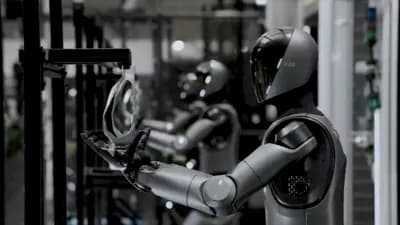
Figure AI's home-focused third-gen humanoid, TIME Best Invention 2025, with wireless charging and 2x faster actuators. 240 units/month shipping as of April 2026.
Overview
The Figure 03 is a humanoid developed by Figure AI (USA), first announced in 2025 (shipping since 2025). It is commercially available. Standing 168 cm tall, weighing 60 kg, with 44 degrees of freedom, it can carry payloads up to 20 kg. Performance highlights include a top speed of 1.2 m/s, a battery runtime of 300 minutes. The platform is powered by Proprietary (runs Helix VLA model onboard), equipped with Next-gen camera array (2x framerate, 60% wider FOV), tactile fingertip sensors (~3g sensitivity).
Figure 03 — use cases
Household chores under Helix VLA
Figure 03 is the first Figure platform designed primarily for unstructured home work — laundry sorting, dishwasher loading, tidying, table setting, and fetching items between rooms. Tasks run on Helix, Figure's in-house Vision-Language-Action model that learns from teleoperation demonstrations rather than scripted programming. Figure has published demo footage of household sequences from its Sunnyvale lab, but has not disclosed per-task success rates, average time per task, or how long Helix runs autonomously between human resets.
Continuous duty cycle via wireless charging
Inductive charging coils sit in the soles of the feet. The robot walks onto a 2 kW charging mat between tasks, which Figure designed to remove the need for a human to plug it in. Combined with the 2.3 kWh battery and the stated 5-hour runtime, the engineering target is opportunistic top-up rather than a daily charge cycle. Charge-to-full time at 2 kW has not been published, and 2 kW is below the typical 6.6–11 kW seen in EV onboard chargers, so a full recharge will take noticeably longer than the runtime it buys.
High-resolution tactile manipulation
Each fingertip carries a sensor rated at 3-gram force sensitivity — the weight of a paperclip. Figure positions this as the enabler for picking up eggs, handling soft fabric, and stacking dishes without breakage. The palm also carries an additional camera, which Helix fuses with the head cameras for in-hand object tracking. The fingertip sensor count, sample rate, and dynamic range have not been disclosed in Figure's October 2025 reveal materials.
mmWave data offloading for fleet learning
Figure 03 ships with a 10 Gbps mmWave radio used to upload episode data to Figure's training infrastructure when the robot is on its charging mat. The design intent is a continuous data flywheel: each home becomes a source of Helix training episodes covering the long tail of household environments that a lab cannot reproduce. Figure has not described what episode data is uploaded, the consent model, or how user data is partitioned from training pools.
Beachhead pricing against enterprise siblings
Figure has stated a consumer target of approximately $20,000 — roughly one-seventh of the $130,000–$150,000 enterprise price band of Figure 02. The pricing posture reframes Figure 03 as a volume play, with the BotQ production line designed for an initial 12,000 units per year and a four-year goal of 100,000 units. As of April 2026 Figure reported 240 units per month shipping, ramping toward 55 units per week (roughly one robot per hour) at the BotQ facility.
Version history
Figure 01 — Unveiled October 2023
First Figure walking prototype. Six-DoF hands, single camera set, dependent on remote OpenAI speech-to-speech for natural-language interaction. Used internally for early Helix training data collection. Never shipped to external customers.
Figure 02 — August 6, 2024
Second-generation enterprise platform. 16-DoF hands, six RGB cameras, dual onboard NVIDIA GPU modules, 2,250 Wh battery, 300-minute runtime. Stayed at 168 cm / 70 kg. Deployed at BMW Spartanburg under a January 2024 Letter of Intent. Enterprise list price reported in the $130,000–$150,000 range.
Helix VLA on-device — February 2025
Software-side shift. Figure announced Helix as its own Vision-Language-Action model, trained on internal teleoperation data and running entirely on the dual onboard GPUs. Replaced the prior OpenAI runtime dependency. Helix shipped to existing Figure 02 hardware via update rather than a new build.
Figure 03 — Announced October 2025
Home-targeted third generation. Height stays at 168 cm, weight drops to 60 kg (from 70 on Figure 02), payload drops to 20 kg (from 25), DoF rises to 44. New 2.3 kWh battery rated at 300 minutes. Wireless charging via 2 kW foot coils, 10 Gbps mmWave data link, palm cameras and 3-gram fingertip sensors added. Camera system rated at twice the framerate, one-quarter the latency, and 60% wider field of view per camera. TIME named Figure 03 a Best Invention of 2025. Production at the BotQ facility opened to early Alpha Home partners; broader home availability targeted for late 2026.
Deployment evidence
Figure BotQ facility, Sunnyvale, California
Primary manufacturing site for Figure 03. Figure published production data showing throughput rising from one robot per day in late 2025 to roughly one per hour by mid-2026, with 350+ cumulative units delivered. First-year capacity stated at 12,000 units; long-term plan calls for 100,000 units over four years.
Source: Figure AI, Ramping Figure 03 Production, 2026; Humanoids Daily coverage
Alpha Home partner program
Figure has placed Figure 03 units with a small number of unnamed early-access households for data collection and feedback. The program has not been publicly enumerated; Figure has neither disclosed partner identities nor the number of homes in the program.
Source: Figure AI, Introducing Figure 03, October 2025
Enterprise reuse from Figure 02 customers
BMW Manufacturing in Spartanburg remains the named enterprise deployment for the Figure 02 platform. Figure has not publicly confirmed whether Figure 03 units have replaced or supplemented Figure 02 at BMW or at any other enterprise site.
Known limitations
Not yet shipping to consumers
As of mid-2026, broader home availability is still targeted for late 2026. The Alpha Home program is small and unnamed. Most public material describes capability that has been demonstrated, not capability that has been delivered into uncontrolled household environments.
Vision-only sensing, no LiDAR
Figure 03 keeps the camera-only sensing approach of Figure 02 — head cameras, palm cameras, and tactile fingertips, with no LiDAR or structured-light depth sensor. The same failure modes apply: degradation under low contrast, glare, glossy floors, and dim ambient lighting. Figure has not published a failure-mode analysis under realistic household lighting conditions.
Closed software stack
No ROS or ROS 2 support, no public SDK, no third-party developer program. Helix is internal to Figure. Research groups and integrators that want open access remain on Unitree H1/G1, Agility Digit, or Boston Dynamics Atlas Research.
Manufacturer-quoted runtime
The 5-hour figure is Figure's own number. Duty cycle, payload conditions, and the load profile of fingertip and palm actuation are not specified. Continuous-work runtime under sustained household chores has not been published. The same caveat applied to Figure 02's 300-minute rating and remains unresolved at the platform level.
Home safety certification gap
No UL or IEC safety standard yet covers an autonomous mobile humanoid operating around children, pets, and stairs in private homes. Figure has not disclosed which certifications Figure 03 has obtained for the consumer release, nor what insurance posture Alpha Home households operate under. This is an industry-wide gap, not specific to Figure, but it gates the late-2026 broader-availability target.
How Figure 03 compares
vs. 1X NEO
NEO is Figure 03's closest peer by mission: a home-targeted humanoid at a $20,000 price point with consumer deliveries targeted in the same late-2026 window. NEO is lighter at 30 kg against Figure 03's 60 kg and quieter (1X states 22 dB operating noise), with 22-DoF hands and a soft-body 3D-lattice polymer cover designed to reduce impact risk in shared living space. NEO uses a tendon-driven actuation scheme rather than Figure's geared actuators, which is part of why it weighs half as much. 1X has opened public preorders with a $200 deposit plus a $499/month subscription option; Figure 03 has not opened public preorders and operates a closed Alpha Home program. Both ship without ROS support and run proprietary AI stacks. The split is design philosophy: NEO optimizes for soft and quiet, Figure 03 for actuator strength and tactile precision.
vs. Tesla Optimus Gen 3
Optimus Gen 3 targets the same $20,000–$25,000 consumer band as Figure 03 and 1X NEO but is not yet shipping outside Tesla. Tesla rates Optimus Gen 3 at 25 kg payload against Figure 03's 20 kg, and quotes 540 minutes of runtime against Figure's 300 — both manufacturer numbers without independent verification. Tesla retains vision-only sensing and no ROS, matching Figure's stack philosophy. The substantive split is the go-to-market: Tesla has prioritized internal Fremont and Giga Texas deployment to refine the platform before consumer release, while Figure has skipped a comparable internal industrial phase for Figure 03 and gone directly to Alpha Home partners. Tesla's manufacturing volume target is the most aggressive of the three; Figure's BotQ 12,000-unit first-year figure is the most concrete published number.
vs. Figure 02
Figure 03 is not a successor to Figure 02 in the usual sense — both platforms remain in production, aimed at different markets. Figure 02 stays as the enterprise platform: 70 kg, 25 kg payload, $130,000–$150,000 price band, BMW Spartanburg deployment. Figure 03 trades 10 kg of mass and 5 kg of payload for a smaller home-friendly footprint, adds palm cameras and 3-gram fingertip sensors, swaps wired charging for 2 kW foot inductive, and drops the price band by roughly seven-fold. Both run the same Helix VLA model, which lets Figure share a single training corpus across the two product lines. The comparison clarifies Figure's product strategy: enterprise units generate revenue today, home units generate training data at scale to compound Helix quality across both platforms.
Specifications
Height
168 cm
Weight
60 kg
DOF
44
Payload
20 kg
Runtime
5h
Max Speed
1.2 m/s
Battery
—
Charge Time
—
Stairs
Yes
LiDAR
No
Compute
Proprietary (runs Helix VLA model onboard)
ROS
None
Platform
Sensors
Next-gen camera array (2x framerate, 60% wider FOV)tactile fingertip sensors (~3g sensitivity)
Operating System
Proprietary
Last updated: 2026-06-23 · Announced 2025 · Shipped 2025
FAQ
Q.What is the price of Figure 03?
The Figure 03 price has not been officially announced yet.
Q.What are the specs of Figure 03?
Figure 03 features 44 DOF, 168cm, 60kg, 20kg payload, 300 min runtime. Proprietary (runs Helix VLA model onboard), no ROS.
Q.Is Figure 03 available to buy?
Yes, Figure 03 is currently shipping to customers.
Q.Who makes Figure 03?
Figure 03 is made by Figure AI, headquartered in USA. Official manufacturer site: https://www.figure.ai.
Q.Does Figure 03 support ROS?
Figure 03 does not list official ROS support. Figure AI ships Figure 03 with a proprietary software stack; third-party ROS integration is not officially endorsed.
Q.How long does the Figure 03 battery last?
Figure 03 runs for approximately 5h on a single charge.
Q.What payload can Figure 03 carry?
Figure 03 is rated to carry up to 20 kg of payload, suitable for industrial logistics and warehouse workloads.
Q.How fast is Figure 03?
Figure 03 has a published maximum walking speed of 1.2 m/s and can navigate stairs.
Q.What are alternatives to Figure 03?
Closest specs-wise alternatives to Figure 03 include L7 by RobotEra, Phoenix by Sanctuary AI, Optimus Gen 2 by Tesla. Full head-to-head comparison: https://biorobot.ai/en/vs/figure-03-vs-robotera-l7.